From Hanoi to Nanning: A Vietnamese Student’s Railway to the Future
When Nguyen Thi Minh Nguyet boarded the train from Hanoi to Nanning in the summer of 2024, she didn’t expect the journey to take 12 hours. The hard-seat carriage smelled of instant noodles and sweat, and by the time she arrived at Guangxi University, her excitement about studying in China had dimmed considerably. Two years later, sitting in the university library, she reads the news on her phone: the Hanoi-Nanning high-speed rail is expected to open in 2028, cutting travel time to just three hours. She smiles. This railway won’t just change the distance between two countries—it will change the trajectory of young Vietnamese lives like hers.
23,500 Choices and Counting
According to the Chinese Embassy in Vietnam, approximately 23,500 Vietnamese students are currently studying in China, making Vietnam the sixth-largest source of international students. Behind this number lies simple economics: annual tuition at Guangxi University ranges from 15,000 to 20,000 RMB (roughly 50-70 million VND), a fraction of what Western universities charge. More importantly, Chinese government scholarships offer hope to Vietnamese families—in 2026, the embassy awarded scholarships to 34 Vietnamese students covering undergraduate, master’s, and doctoral programs.
But scholarships tell only part of the story. Guangxi Normal University and Guangxi University have seen steady growth in Vietnamese enrollment, not just because of affordable tuition, but because geographic proximity creates cultural comfort. Nanning sits just 400 kilometers from Hanoi; the similar language, food, and climate help Vietnamese students adapt quickly. “The first time I walked into the cafeteria at Guangxi University and saw a pho station,” Nguyet recalls, “I knew I’d made the right choice.”
From Chinese Language to Digital Economy: A Quiet Shift in Majors
A decade ago, Vietnamese students in China had essentially two choices: Chinese language studies or international business. Today, that list is expanding rapidly. Guangxi University’s 2026 admissions brochure now includes digital economy, artificial intelligence, and new energy technology—precisely the fields Vietnam’s economic transformation demands most.
Vietnam’s National Digital Economy Development Strategy through 2030 targets digital economy at 30% of GDP. Achieving this goal requires massive numbers of digitally skilled professionals. Yet Vietnamese universities still lack resources in cutting-edge fields like AI and big data. Chinese universities, by contrast, have reached global frontiers—72 Chinese institutions appear in the 2026 QS World University Rankings, with Tsinghua and Peking University both ranking in the global top 20 for computer science.
This shift in major selection reflects increasingly pragmatic Vietnamese students. Nguyet chose cross-border e-commerce not because it sounds trendy, but because she sees the demand: “On platforms like Shopee and Lazada, Vietnamese people who understand Chinese and China’s supply chain are incredibly sought after.”
The Railway: A Visible Career Path
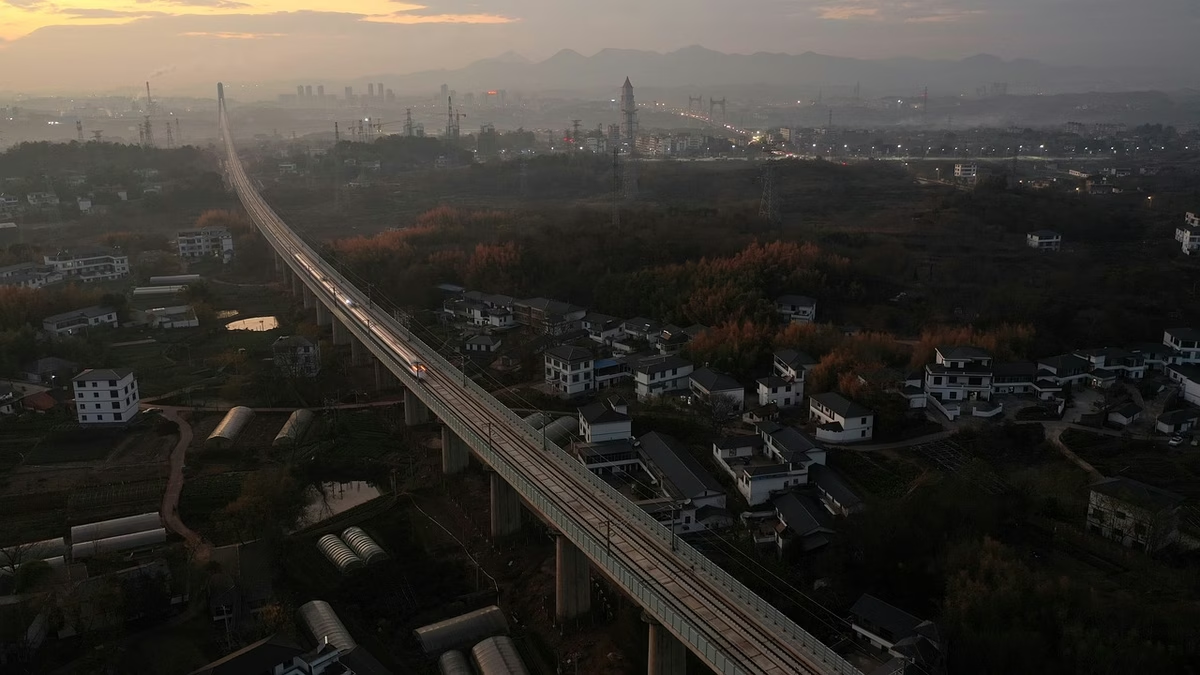
If major selection reflects long-term planning, the China-Vietnam high-speed rail project offers something concrete—a career path you can see and touch. The 2025 China-Vietnam joint statement explicitly commits both sides to railway cooperation, advancing planning for routes including Hanoi-Dong Dang and Hai Phong-Ha Long-Mong Cai. This means Vietnam will need thousands of railway professionals over the next decade: from track design and signaling systems to operations management and cross-border logistics.
Guangxi Liuzhou Railway Vocational and Technical College has already moved first, signing cooperation agreements with Vietnam’s railway sector to provide technical training. This isn’t just educational cooperation—it’s talent pipeline development. For Vietnamese students, studying railway engineering in China means potentially working on the China-Vietnam high-speed rail after graduation—a direct path from campus to construction site.
Cross-border logistics deserves even more attention. China-Vietnam trade surpassed $200 billion in 2025, with China consistently Vietnam’s largest trading partner. As high-speed rail boosts logistics efficiency, Vietnamese talent fluent in Chinese and familiar with China’s market will become scarce resources that Chinese companies fiercely compete for. Huawei and Alibaba have established regional headquarters in Vietnam, and their 2026 campus recruitment explicitly prioritizes graduates with Chinese study backgrounds.
For Those Still Hesitating
If you’re a Vietnamese high school student considering whether to study in China, here’s a simple framework:
Step 1: Define your goal. What do you want to study? Where do you want to work after graduation? If your target is a Chinese company or China-Vietnam trade, studying in China is virtually essential. If you’re interested in technology, universities in Guangxi and Yunnan offer the best value.
Step 2: Calculate the real cost. Tuition plus living expenses at Guangxi universities total roughly 30,000-50,000 RMB per year (about 100-170 million VND)—far less than the West. For top students, China Government Scholarships (CSC) are available—check the Chinese Embassy in Vietnam website for 2026 deadlines, typically February through April.
Step 3: Prepare your language early. Most programs require HSK Level 4 or above. If you have no Chinese foundation yet, start systematic study in your final year of high school. Guangxi University and Guangxi Normal University both offer language preparatory programs to ease the transition.
Nguyet’s advice is simple: “Don’t overthink it—just come. Once you’re here, you’ll find more opportunities than you ever imagined.” Two years after arriving, she’s already interning at a Chinese cross-border e-commerce company earning 5,000 RMB monthly—considered high for a Vietnamese fresh graduate. Her story is just one of 23,500 Vietnamese students currently studying in China, each writing their own chapter in a rapidly evolving bilateral relationship.